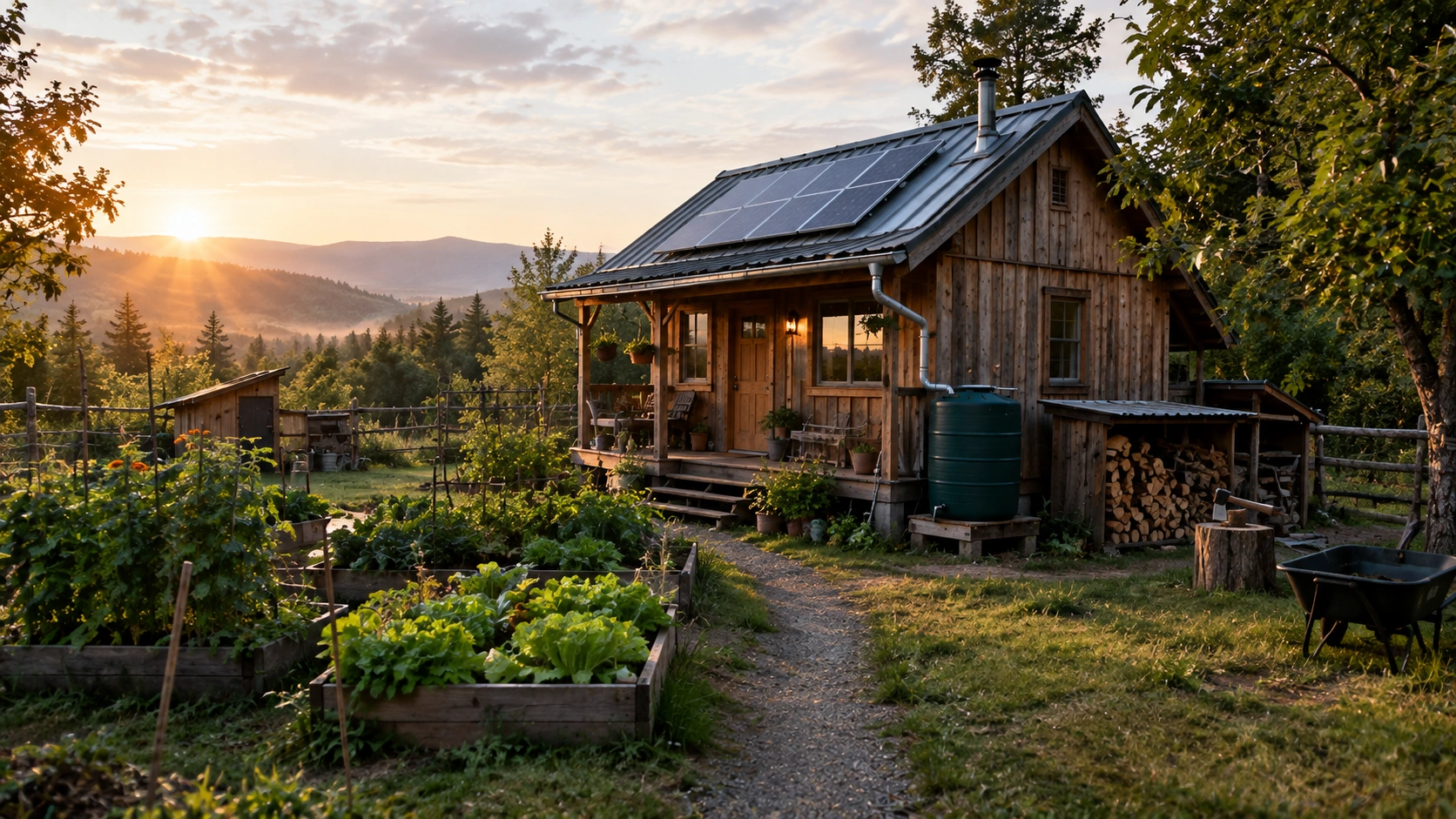
Off-grid living looks wonderfully simple in photos. A small house, a few solar panels, raised garden beds, maybe some chickens, and enough land to disappear from the noise of everyday life.
Then the ordinary stuff starts.
You need water while the garden needs watering. A tool is needed at the far end of the property. The battery is low on a cloudy afternoon. Something leaks. Firewood needs moving. Food needs storing. Suddenly, the dream is less about independence and more about how many unnecessary jobs your property has created.
That is the part most off-grid plans don’t show.
Starting an off-grid lifestyle isn’t really about collecting the right equipment. It’s about designing a place where the things you do repeatedly are easy to do repeatedly.
A small home can work surprisingly well for this. In fact, limited space can force better decisions. The trick is to build around your actual routine rather than trying to recreate somebody else’s perfect homestead.
Before You Buy Anything, See What the Property Is Really Offering
A property can look ideal on paper and still be awkward to live on.
Spend some time there before deciding where anything goes. Watch where sunlight reaches during different parts of the day. Notice which areas stay wet after rain, where the ground slopes, where vehicles can actually reach, and which parts you naturally walk through.
Don’t look only at the total acreage, either.
A five-acre property doesn’t mean you have five convenient acres. Some of it might be wooded, steep, rocky, wet, heavily shaded, or simply too far from the house to make sense for everyday use.
That changes how you should think about the land.
A useful question is:
How much of this property can I realistically use without making my daily life harder?
The answer matters more than the number on the listing.
Before committing to a property, also investigate local rules around dwellings, septic systems, wells, water use, livestock, access roads and other structures. “Rural” doesn’t automatically mean every off-grid idea is permitted.
It’s much cheaper to discover a restriction before buying land than after you’ve already planned your entire lifestyle around it.

Design the Property Around Your Daily Routes
Here’s a simple way to test an off-grid layout: imagine an ordinary Tuesday.
You wake up. You make breakfast. You need water. You check the garden. You grab a tool. You bring something back to the house. Later, you collect food, deal with laundry, check equipment and perhaps carry something to storage.
Now imagine doing all of that while the garden, water tank, workshop and storage shed are scattered around the property.
Nothing is technically wrong. Yet you’re constantly walking, carrying and retracing your steps.
That hidden workload can become one of the biggest problems in off-grid living.
Think about frequency, not just distance.
Things you use every day should generally be easiest to reach. Things you visit once a week can be farther away. Occasional-use areas can occupy the less convenient parts of the property.
For example, a kitchen garden makes more sense close to the house than at the back of a large field if you’ll be harvesting from it every day. A workshop doesn’t necessarily need to sit beside the kitchen. A timber area can be farther away because you aren’t collecting wood every hour.
This is where a small home can actually be an advantage. Limited space encourages you to ask what deserves to be nearby.
You’re not just designing buildings.
You’re designing the routes between them.

Solve the Whole Water Problem, Not Just the Water Source
It’s easy to become focused on finding a well, spring or rainwater collection system.
But finding water isn’t the end of the problem.
You still need to answer four questions:
Where does it come from? Where is it stored? How does it reach the point of use? Where does it go afterward?
That last question is easy to overlook.
Water entering the home eventually becomes wastewater. Kitchen use, showers, toilets and laundry all create another side of the system that needs to be handled appropriately.
Think of the complete chain rather than purchasing individual components:
source → storage → distribution → use → wastewater
This also changes how you place things.
Suppose your water storage is technically adequate but the garden is positioned where watering requires long hose runs, repeated pumping or constant carrying. The system may work, but the daily routine will be annoying.
Season matters too. A water setup that feels generous during a mild period may feel very different during a hot, dry stretch when plants need more attention.
If the land has useful elevation changes, gravity may sometimes help move stored water. Where pumps are necessary, make sure they can be reached for maintenance instead of burying every important component behind other structures.
The best water system isn’t simply the one that provides enough water.
It’s the one you can operate and maintain without fighting the property.

Build Your Power System Around Your Actual Life
Buying solar equipment before understanding your electricity habits is an easy way to overspend.
Start with your routine.
What absolutely needs electricity? What would be convenient but could wait? What only gets used occasionally?
A refrigerator, water pump, basic lighting and communication devices may matter much more to your everyday life than a power-hungry appliance or workshop tool.
And don’t think only about the amount of electricity.
Think about where and when you need it.
If your workshop is far from the house, powering tools there may involve a different setup from powering the refrigerator in your living space. A greenhouse, barn or detached workspace can add another layer of wiring, storage or equipment.
Cloudy periods matter too. A system that feels comfortable on a bright day may feel very different when solar production falls and several essential loads still need to run.
The goal isn’t to eliminate every electrical convenience.
It’s to know which conveniences are worth designing the system around.
A useful exercise is to write down what you use in a normal week. Then separate those needs into three groups:
| Daily essentials | Useful but flexible | Occasional |
| Refrigerator | Laundry | Power tools |
| Water pump | Extra appliances | Workshop equipment |
| Basic lighting | Larger cooking loads | Other non-essential loads |
| Communication | Other convenience devices | Seasonal equipment |
That list will tell you much more than guessing your solar needs from the size of your house.

Grow Food Before You Commit to Livestock
A garden is more than a way to produce vegetables.
It’s a test of your property and your available time.
You learn how quickly the soil dries out, where pests appear, how often plants need attention, how much watering is involved, and how much work harvesting and storing food creates.
Start with food you already eat.
There’s little value in growing something simply because it looks impressive in a homesteading video if nobody in the household wants to eat it.
Livestock deserves even more caution.
Chickens, goats and other animals can certainly contribute to a homestead, but they turn food production into a daily responsibility. They need water, feed, shelter, fencing and regular care. Bad weather doesn’t cancel those jobs.
Before bringing animals home, ask yourself a less exciting but more useful question:
Can I still maintain this routine on a week when I’m busy, tired or dealing with another problem?
If the answer is no, the issue isn’t your acreage.
It’s your workload.
That distinction can save you from building a homestead that looks productive while quietly becoming a full-time obligation.

Make Repairs Easy Before Something Breaks
Off-grid equipment doesn’t need to fail dramatically to become a problem.
A small leak, damaged fence, clogged filter or malfunctioning pump can be enough to disrupt your routine.
The mistake is designing everything neatly without considering how you’ll reach it later.
Imagine a water pump installed behind a storage area. It looks tidy when everything is new. Six months later, the pump needs attention, but getting to it means moving heavy containers and dismantling part of the setup.
The original installation was convenient.
The repair isn’t.
Leave working space around equipment that may need maintenance. Keep frequently used tools where they are easy to grab. Don’t bury important connections simply because hiding them makes the property look cleaner.
This is especially important in a small home, where every inch tends to get claimed quickly.
Storage should make repairs easier, not merely hide clutter.
A little unused space around important equipment can be more valuable than another shelf.

Design for the Week When Everything Isn’t Going Right
The easiest mistake is designing an off-grid system around ideal conditions.
The sun is shining. The garden is dry enough to walk through. The water source is behaving normally. Nothing needs repairing.
That’s not everyday life.
Ask what happens when the weather turns unpleasant.
Can you reach the garden after heavy rain? Can you get to the water equipment without crossing a muddy section? Can you access your tools when you’re carrying something else? What happens if several cloudy days reduce solar production? Can you still perform essential tasks without making five extra trips?
You don’t need to build a disaster bunker.
You simply need to test the property against ordinary inconvenience.
If a system only works beautifully when everything goes right, it isn’t a very forgiving system.
A good layout gives you options.
Don’t Turn Every Acre Into a Project
There is a strange pressure in homesteading culture to make every piece of land productive.
- Another shed.
- A garden here.
- Animals there.
- An orchard over there.
- A workshop.
- A greenhouse.
Then suddenly your “simple” lifestyle has become a collection of projects that all need maintenance.
Unused land isn’t necessarily wasted land.
A section can remain wooded, natural or undeveloped because you don’t currently need it. Leaving an area alone can reduce mowing, watering, fencing, construction and maintenance.
This matters even more when you’re starting out.
You don’t have to prove that you’re serious about homesteading by developing every corner of your property.
Sometimes the smartest piece of land is the one you deliberately leave alone.
Make Profitability a Separate Decision
This is where profitable off-the-grid homesteading becomes more complicated than many articles make it sound.
Producing something isn’t the same as making money from it.
Suppose you grow vegetables for sale. Your revenue isn’t the only number that matters. You also spend time preparing the soil, watering, harvesting, cleaning, packaging, transporting and finding customers.
The same problem can happen with eggs, honey, seedlings, preserved foods or other small-scale products.
A better question is:
What can this property produce that people actually want, and can I produce it without creating a workload I don’t want?
That may lead to a completely different answer for each homestead.
For one person, a small garden surplus sold locally might make sense. For another, seedlings may require less ongoing space than livestock. Someone with useful skills might discover that income connected to the homestead—such as consulting, digital work or another service—is more practical than trying to turn every acre into a farm business.
Don’t confuse self-sufficiency with profitability.
They can support each other, but they aren’t the same goal.
A productive homestead might save money by growing some food without generating much income. A profitable enterprise might require buying supplies that have little to do with self-sufficiency.
Decide what you actually want the property to accomplish before adding a business to it.
Let the First Year Change Your Mind
Your first plan is going to be wrong in some places.
That’s not a problem.
You may discover that the sunny spot you chose for the garden is inconvenient to reach. You may learn that a particular area stays wet longer than expected. You might find yourself using one tool constantly while another sits untouched.
Pay attention to those discoveries.
Instead of asking, “How do I make my original plan work?” ask:
“What is the property teaching me about how I actually live here?”
That mindset makes the first year useful.
Keep track of recurring frustrations. Notice what takes longer than expected. Pay attention to seasonal changes. If you repeatedly walk across the property for the same reason, that’s a design signal.
If something constantly needs maintenance, that’s another signal.
If an area you planned to develop never gets used, leave it alone.
Your second version of the homestead should be based on what actually happened—not what you imagined before moving in.
Build for Ordinary Days, Not the Homestead You See Online
The most impressive off-grid property isn’t necessarily the most successful one.
A beautiful garden doesn’t help if you’re exhausted by watering it. A large workshop doesn’t add much value if reaching it means a long walk every time you need a screwdriver. More animals don’t automatically create more independence. More land doesn’t automatically make life easier.
The real test is much less exciting.
Can you get water without a hassle?
Can you find your tools?
Can you repair the pump?
Can you harvest something for dinner without turning it into a project?
Can the property still function when the weather is unpleasant?
Can you earn a little from it without creating a job you never wanted?
That’s what makes an off-grid lifestyle sustainable over the long term.
A small home can be enough. You don’t need to build the biggest garden, install the most elaborate power system or develop every available acre.
Small land asks you to manage space. Large land asks you to manage distance. Both ask you to manage your time.
The best off-grid homestead is therefore not the one that produces the most impressive photograph. It’s the one that quietly supports the life you actually want to live.